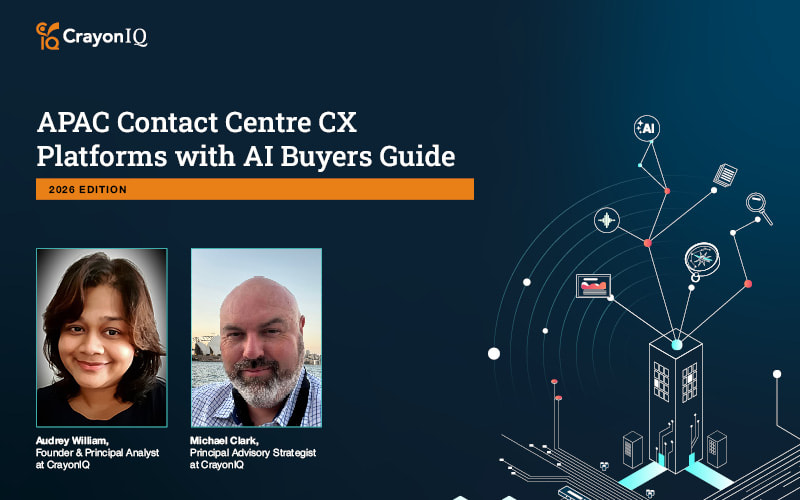
The enterprise contact centre market is undergoing its biggest structural shift in more than a decade, according to the newly released 2026 APAC Contact Centre CX Platforms with AI Buyers Guide from independent research and advisory firm, CrayonIQ.
The report finds organisations are no longer simply selecting contact centre platforms. Instead, procurement is increasingly driven by broader decisions around AI strategy, cloud infrastructure, enterprise architecture, governance and data platforms.
Audrey William, Founder and Principal Analyst at CrayonIQ
“Over the past twelve months we’ve seen the buying conversation change dramatically,” said Audrey William, Founder and Principal Analyst at CrayonIQ. “Organisations are asking fewer questions about contact centre features and far more about AI governance, commercial models, security, interoperability and long-term platform strategy. The contact centre is no longer a standalone technology decision. It has become part of a much broader enterprise AI conversation.”
Michael Clark, co-author of the report and Principal Advisory Strategist at CrayonIQ, points to concrete evidence of this change in the Australian public sector. “The biggest indicator that contact centres are becoming part of enterprise architecture is the ATO [Australian Taxation Office] tender earlier this year. They didn’t go to market for a contact centre platform; they went to market for enterprise interaction capabilities. That is a pretty fundamental shift.”
The 2026 APAC Contact Centre CX Platforms with AI Buyers Guide independently evaluates twenty of the region’s leading customer experience and contact centre platforms across AI capability, platform maturity, commercial strategy and enterprise readiness.
Five findings defining the next phase of customer experience
The contact centre is no longer buying contact centre technology
The report identifies a significant shift in enterprise buying behaviour. Technology decisions that were traditionally led by customer service and contact centre teams are increasingly being influenced by CIOs, enterprise architects and AI governance functions as organisations seek to align customer experience investments with enterprise-wide AI strategies.
Michael Clark, co-author of the report and Principal Advisory Strategist at CrayonIQ
As Michael Clark explains, “In the past, the decision was often about what the contact centre manager wanted and needed to run their operation. Now, it’s more about the overall operating model and how the contact centre fits into it. AI is driving a lot of that change. What’s changing is that data architecture, AI governance, workforce design, and operating models are all part of the equation now. Once you start talking about those things, you’re bringing in CIOs and CFOs. The contact centre is no longer a silo; it is a critical piece of the broader enterprise architecture.”
This architectural shift has rewritten the rulebook for C-suite alignment and governance risk. “Increasingly, it’s no longer just about having the CIO in the room with the board,” says Audrey William. “It’s the Chief AI Officer, the Chief Customer Officer, and the CFO who is becoming the real sponsor. Boards are treating AI and CX as governance topics. They are asking: Who is accountable? Is this going to affect our reputation? What are the guardrails? Two years ago, leaders were asking if they could deploy a tool. Now they are asking, ‘If something goes wrong, who owns the kill switch, and under what rules?’ The conversation has completely shifted from basic feature comparisons to deep questions of ownership, data control, and ultimate risk management.”
Asian language AI has become a major competitive differentiator
For organisations operating across Asia Pacific, multilingual AI has moved beyond being a desirable capability to becoming a strategic requirement. The report highlights increasing enterprise demand for high-quality AI support across Japanese, Korean, Mandarin, Thai, Vietnamese, Bahasa Indonesia, Bahasa Malaysia and other regional languages, reflecting the complexity of delivering consistent customer experiences across diverse markets.
“From an Asia-Pacific lens, things get tricky due to data sovereignty fragmentation,” notes Audrey William. “Countries like Japan, India, and Indonesia want to work with local telcos and local systems integrators. The buying conversation has completely shifted from features to AI governance, commercial models, and navigating local compliance.”
I think what you’re also going to see is an emergence—I mean, it’s already happening right now—of a lot of local Southeast Asian specialists that want to come in here, knowing that the global vendors will need their help for cultural nuances and dialects. A vendor that I can call out here is Toku in Asia, because they’re actually addressing this challenge. They partner with many of the leading vendors and help them address this important area by working through multiple LLMs, whilst making sure that regional, country-specific dialect is firmly in place.”
AI pricing is becoming as important as AI capability
As AI becomes embedded across customer operations, enterprises are placing greater scrutiny on tokenisation, inference costs and consumption-based commercial models. The report concludes that transparency and predictability of AI pricing are emerging as significant differentiators between vendors.
“The CEO wants to know how AI will make them stand out as a brand without causing reputational damage,” William outlines. “Meanwhile, the CFO is focused on consumption-based pricing so they don’t have to rip and replace everything. But the massive discussions right now are around enterprise architecture, data, and change management—do they need to completely re-architect the contact centre, and what is the new operating model?”
The market has split into five distinct procurement pathways
The first is the Contact Centre Platform-Led model, where organisations begin with specialist providers such as Genesys, Verint, NiCE, and Cisco. This remains the most common approach, particularly in regulated industries.
The second is the CRM and Service Platform-Led model, where orchestration begins in enterprise applications such as Salesforce, Microsoft, ServiceNow, and Zendesk.
The third is the Developer and API-Led model, led by programmable communications providers such as Twilio and Vonage, which appeal to digitally mature enterprises seeking composable architectures.
The fourth is the Hyperscaler and AI Platform-Led model, where procurement is increasingly CIO-driven and aligned with broader cloud strategies.
The fifth emerging trend is the disruptive entry of AI-Native Vendors acting as an overlay.
Audrey William notes that these AI-native vendors are challenging legacy economics, “AI-native vendors in the market are selling outcome-based pricing for autonomous resolution. And that’s their entire economic engine. What they’re saying is – it doesn’t matter what contact centre solution you have, we will sit on top of that and be the overlay.'”
Michael Clark agrees that this plug-in layer offers a compelling proposition for complex environments, “You’re looking at a traditional procurement pathway, where you’re buying a contact centre platform, you’re buying a CRM, and then you’ve now got an AI-native who comes in and says, ‘Hey, you can keep all that capability, and we’ll just plug into it.’ That can be very attractive.”
Hyperscalers are changing the competitive landscape
The report concludes that Amazon Web Services, Microsoft and Google Cloud are reshaping enterprise customer experience through their ability to combine AI, cloud infrastructure, enterprise data and platform services into integrated technology ecosystems.
As a result, traditional contact centre vendors increasingly compete within broader enterprise technology decisions rather than purely against other CCaaS providers.
To illustrate this, Michael Clark points to a major regional migration, “Westpac New Zealand, were on a Genesys Cloud solution and have moved to Microsoft. They took that road because their data sat across a Microsoft layer, enabling them to better manage their customers and data.”
From product features to organisational transformation
“The winners over the next five years won’t necessarily be the vendors with the longest feature lists,” William said. “They’ll be the organisations that simplify AI adoption, provide transparent commercial models and help customers connect data, governance and automation into a coherent operating model.”
To survive, both authors stress that the technology industry must pivot away from feature-selling. Michael Clark remarks, “I think what we’re seeing, and what we’ve seen in the last year or so, is everyone selling AI. These are the new features we’ve got, this is the new capabilities we’ve got. Vendors should stop selling AI and start selling organisational transformation.”
Elevating the consulting ecosystem
The report also stresses the importance of vendors having a solid partnership framework in the Asia Pacific region. The discussions in boardrooms with C-level decision-makers are increasingly being led by global consulting specialists, local consulting specialists and specialist AI partners. The consulting-led approach in sales will increasingly become important, setting a new benchmark by elevating discussions beyond the technology to change management, forward-deployed engineering and the outcome-as-a-service model.
Designed for CIOs, Chief Customer Officers, Heads of Customer Service, Contact Centre Executives, Enterprise Architects and procurement leaders, the 2026 APAC Contact Centre CX Platforms with AI Buyers Guide provides independent analysis to support technology evaluation and investment decisions across one of the world’s fastest-moving customer experience markets.
About the 2026 APAC Contact Centre CX Platforms with AI Buyers Guide
The 2026 APAC Contact Centre CX Platforms with AI Buyers Guide independently evaluates twenty leading customer experience and contact centre technology providers operating across Asia Pacific.
The report assesses AI capability, platform architecture, voice technology, data and analytics, security, commercial strategy, regional execution and enterprise readiness, while introducing CrayonIQ’s framework for the dominant procurement pathways shaping how organisations acquire customer experience technology.



 “The winners over the next five years won’t necessarily be the vendors with the longest feature lists,” William said. “They’ll be the organisations that simplify AI adoption, provide transparent commercial models and help customers connect data, governance and automation into a coherent operating model.”