Transforming customer experience in a large-scale not-for-profit takes both empathy and operational precision, especially when services support people at moments of vulnerability. At Uniting NSW.ACT, that transformation is being accelerated by embedding service design capability and three practical shifts:
- One cohesive customer function: marketing & sales + customer service + service design + VoC
- Shared language: “people we serve” + Listen/Learn/Act + Moments that Matter
- An evidence base: a “guiding voice” that turns feedback into insight and action
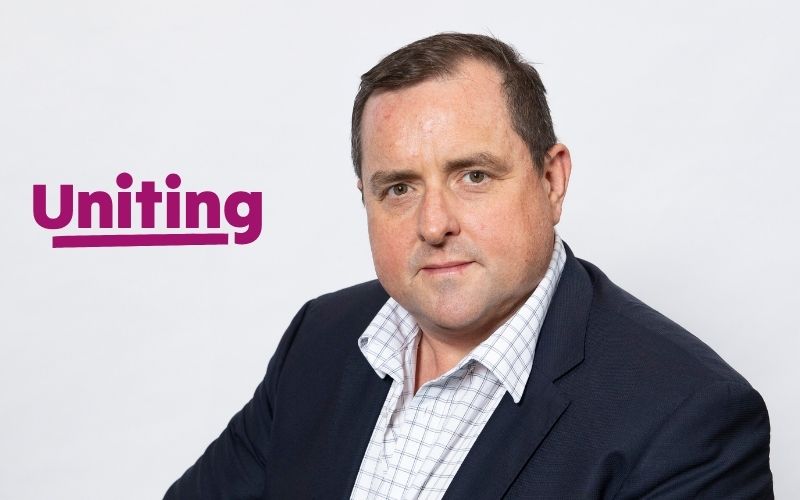
Uniting NSW.ACT is one of Australia’s largest and most prominent not-for-profit community service organisations. With a mission to ‘inspire people, enliven communities, and confront injustice’, the organisation provides a vast network of support services across NSW and the ACT. Chief Customer Officer Stuart Crabb, comments, “Uniting NSW.ACT is a not-for-profit organisation focusing on three core ‘for-purpose’ pillars: social impact and advocacy, communities, and senior services. We are connecting with people across all ages and stages of life, often at moments of vulnerability, and working to create change so that people and communities can thrive.”
Crabb, who brings twenty years of commercial experience from organisations like Johnson & Johnson and Constellation Brands, has been focused on translating values into action, not just statements. Crabb reflects, “I joined about two and a half years ago, bringing a background leading customer, brand and growth roles across product and service environments, then brought that experience into purpose-led human services. I spent 10 years working across the globe and after 20 years with major corporations, I wanted a role with less travel and more social impact.
According to Crabb, “Historically, customer was split. Marketing and sales were in one area, while customer service was entirely separate. Bringing the team together and adding Service Design and Voice of Customer capabilities has given momentum to our work.”
The Uniting NSW.ACT Customer team is focused on turning purpose and values into lived experience at scale, and ensuring the voice of the people they serve shapes how they operate.
‘We work with very different people, from the very young through our Early Learning Centres to older and people in our residential aged care homes. In between, we offer counselling, mediation, homelessness support, social and affordable housing, and support for families among the 350+ services. How we listen matters.’
The power of language in cultural transformation
When looking at actual behavioural change among over ten thousand employees, Stuart’s team highlighted a fundamental truth – technical expertise alone cannot drive transformation if it is not embedded within the cultural fabric of the organisation.
Crabb identified that the standard vocabulary, specifically the term “customer,” did not resonate at Uniting NSW. ACT. The team designs CX to give people facing difficult barriers dignity and equity. To bridge this divide, the language of the organisation pivoted, focusing on ‘the people we serve’.
“We worked with the wider team to co-design our CX framework around the pillars of Listen, Learn, and Act. Our goal is to move the organisation beyond mere compliance toward delivering meaningful experiences by focusing on the ‘Moments that Matter’.
“The linguistic shift was not merely semantic – it was a strategic move to align operational excellence with the social impact goals of the organisation. The goal of this language shift was to episodic tasks like medication administration—toward more intentional experiences that make a person feel comfortable, safe and supported.
“In my current role, I oversee three strategic pillars, marketing and sales, our customer service hub managing customer interactions, and a newly established service design and Voice of the Customer (VoC) department. This is formalised in the People We Serve Framework, which sets out our approach to integrating human-centred design approaches within Uniting. It’s the language we use across the organisation to bring people together along the ‘listen, learn, act’ framing for customer experience. A key pillar of this framework is moments that matter, which become focal points to translate client-led insights into actionable service delivery uplift.
Defining the ‘moments that matter’
Through the People We Serve Framework, Crabb’s team has been able to turn insights from the people we serve into tangible outcomes.
“One example has been a clearer articulation of the connection between the experiences of those we serve and our employees. Core to Uniting NSW.ACT’s ethos has always been that ‘People at the heart of everything we do.’ Through mapping the moments that matter, it’s become possible to show, at the service level, exactly how these two experiences – employee and people we serve – work in tandem.
“At the heart of our mission is a simple fundamental: people. We’ve invested heavily in the employee experience and aligning that with the experience of the people we serve. It’s about getting the ‘mix’ right— ensuring that a happy, engaged workforce naturally translates into exceptional support for the people we serve. We are focused on how these two groups work in tandem to curate a better experience for everyone.”
Though it sounds simple, mobilising a massive workforce that spans both metro and regional areas, and a wide range of services in seniors, early learning and community services carries significant complexities. Many of Uniting NSW. ACT’s services also require localised, in-person approaches, which means looking at digital experiences is not enough to create sustainable change. “While many view CX through the lens of technical or digital transformation, my focus is on people transformation. The challenge lies in mobilising over 10,000 employees to shift their daily actions toward a better experience, and that starts with language.”
“I’ve spent a lot of time analysing how to drive behavioural change at scale. For instance, I initially assumed that ‘Going to sleep’ was the most critical moment in residential aged care, but our insights revealed it was actually the ‘Wake-up moment.’ For residents, that’s what sets the tone for their day. By changing that interaction—knocking before entering a room, and talking to residents about what they want from their day—we create a much more grounded and purposeful experience for them.”
By focusing on this specific interaction, Uniting NSW. ACT creates a more grounded and dignified experience, and fosters a shared language between the resident and employees.
This person-centered care model is formalised in the “People We Serve” framework, a one-page articulation of the organisation’s vision that elevates the model beyond compliance. Uniting NSW.ACT has over 350 services driven by different legislation and rules. The Framework focuses on listening to the Moments that Matter to the people we serve as a driver for change – at Uniting, ordinary daily moments executed extraordinarily well can change the course of someone’s life.
‘By focusing on these Moments, we can critically evaluate and break down how they are delivered. It starts at a local level but branches out into deeper layers of the organisation – systems, culture, capability. Starting small can lead to big impact and ultimately, better outcomes for the people we support.
Building a unified ‘guiding voice’ through data
To support this vision, Uniting NSW.ACT is leveraging advanced data architecture to synthesise a ‘guiding voice’ for the organisation. By moving various governed metrics, such as NPS scores and quality of care indicators, into a centralised data lake, the organisation will then use AI to process raw data and serve it back through Power BI.
This system allows the team to understand the true Voice of the Customer across all channels, transforming feedback into actionable operational insights. Crabb says, “By loading everything—complaints, compliments, constructive feedback and surveys—into one central system, we are helping our people synthesise and understand the true Voice of the Customer”.
Crabb views his role through three macro challenges – coming into service, being in service, and leaving service.
“Regarding ‘in service’ the focus shifts to reducing the cognitive load on our frontline employees. We want to use technology to handle tasks like clinical note-taking so our team members can spend more time directly with the people we serve, rather than being tied up in documentation.”
Balancing automation with the human touch
“As a large services organisation, we need to piece everything together and find synergies across what we deliver. Building trust quickly is a key moment; if you can establish that early, you’ll have a much better relationship. Just like when a doctor asks the right questions and truly knows who you are, we want to help our people build that trust rapidly so we can deliver better services that truly meet their needs.”
Trust is built through asking the right questions and demonstrating true knowledge of the individual, much like a clinical relationship with a trusted doctor. In the contact centre, the team is trialling AI agents to handle high-frequency, transactional tasks such as rescheduling. This triaging process aims to move human agents toward more complex, emotionally loaded problems while maintaining the ability for any caller to opt out and speak to a human within seconds.
Crabb emphasises that in vulnerable moments—such as a family member seeking aged care for a parent or someone facing homelessness – the human connection is paramount. Calls often last longer than those received by a traditional call centre, and the commitment to having a human answer within ten seconds is a key part of the value proposition.
Ethical AI and the future of service
Looking toward the future, Crabb envisions a shift where automation handles friction points, perhaps even involving personal AI agents interacting on behalf of customers. However, the immediate focus remains on ethical AI use and staying relevant as the technology evolves.
By June, Uniting NSW.ACT expects to showcase an industry-leading Voice of the Customer tool called ‘Guiding Voice’, which curates insights across all listening channels, helping the entire organisation move from insight to action.
The success of these initiatives rests on knowing when to introduce technology and how to take the staff on that journey.” It’s about making sure you explain to people how it’s going to evolve their role—what that actually looks like—and then emphasising it as a benefit. For example, moving the organisation toward providing better service experiences, rather than just trying to get massive efficiency out of what we’re doing, can only enhance client outcomes.”
Uniting NSW.ACT is positioning itself as a leader in experience-led services. The executive philosophy is to avoid over-predicting the future and instead remain aware, continue trialling new applications, and ensure that every technological advancement serves the ultimate goal of making a meaningful impact on the people they serve. Through this combination of CX strategy, linguistic alignment, and technological incubation, Uniting NSW.ACT is redefining what it means to deliver support with dignity and respect at scale in the social services sector.
Stuart recently spoke at the Customer 360 Symposium, an event by Ashton Media, held at the Hunter Valley. The next event for this community is the Contact Centre Symposium to be held 12-13 May.