
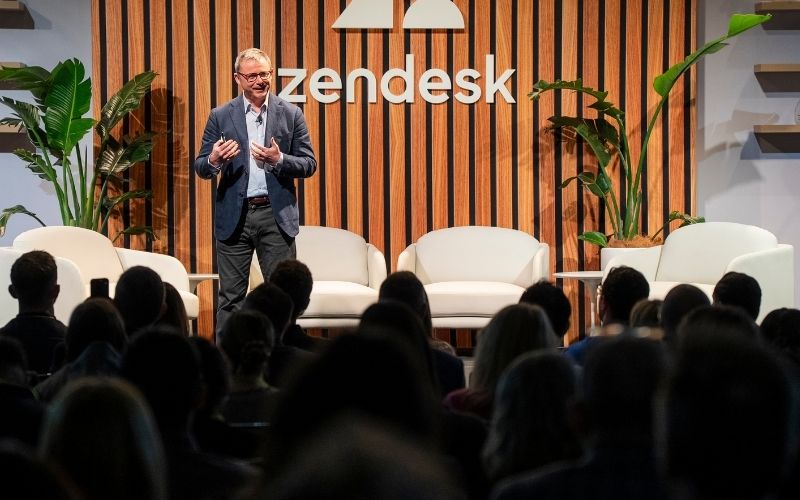
An audience of over 600 professionals across CX, IT, and operations attended Zendesk’s Future of Service event in Sydney last week. The event focused heavily on how AI has become a core component of high-value customer and employee experiences.
As well as showcasing a range of local success stories from brands such as Petstock, MYOB, Netwealth, Our Vacation Centre, Zendesk outlined its future product roadmap and announced a number of new innovations. The keynote sessions featured eight-time Grand Prix winner Daniel Ricciardo, who took the stage with moderator Danica Mason, Australian Sports Journalist. During their session, the former Australian F1 driver shared his personal blueprint for relentless innovation and maintaining a competitive edge.
The primary message of the Sydney event was the transition to Agentic AI. Zendesk emphasised that the goal of AI should not be to simply deflect tickets away from humans, but to resolve them autonomously or provide a ‘Copilot’ that ensures human agents can handle complex issues with greater empathy and speed.

Mitch Young, Zendesk’s SVP Asia Pacific and Japan (APAC), said in the opening keynote, “”We are joined today by a diverse group of leaders across CX, IT, HR, and Operations. While our industries and competitive pressures differ, we share a singular, fundamental challenge – the world of service is shifting beneath our feet. Today, ‘great service’ isn’t measured by closed tickets or answered calls; it’s measured by how we show up for the people who matter most—our customers and our employees. We aren’t just here to talk about AI as a piece of technology – we’re here because AI is the lever that allows us to completely redefine what service looks like in this new era.”
The shift from management to resolution
Young argued that the primary metric for service is evolving. While the industry has historically focused on volumes—such as tickets managed and average handling time—priority is shifting towards end-to-end resolution.
Young shared the following data during the session:
- Adoption: Over 20,000 customers have implemented Zendesk AI.
- Volume: The platform processed nearly 800 million AI-driven interactions in the past year.
- Efficiency: Current agentic AI agents are resolving approximately 80% of customer interactions without human intervention.
“This automation is intended to allow human staff to focus on the remaining 20% of cases, which typically involve higher complexity, risk, or emotional sensitivity”, says Young.

During his keynote, Zendesk CTO, Adrian McDermott identified four distinct milestones that moved AI from a novelty to a sophisticated business engine:
- The Knowledge Era (ChatGPT-3/4): Launched in Nov 2022, this model memorised the internet. It was revolutionary for content creation but limited in reasoning (good for picnic ideas, bad for reliable tax advice).
- The Reasoning Era (OpenAI o1/o3): These models shifted from memorization to logic. They can interrogate, ask follow-up questions, and make decisions. This forced many developers to “throw away” previous AI code and start over to leverage true reasoning.
- The Coding Era (Claude Code/Codex): AI began writing high-quality code. This drove the marginal cost of software toward $0, allowing for mass-generation of software, tools, and digital assets.
- The Agentic Era: This is the current democratisation of AI Agents—autonomous entities that can run indefinitely to solve complex tasks, shifting the focus from human effort to “agentic” output.
The Forethought acquisition
The keynote highlighted the acquisition of Forethought as a significant milestone in Zendesk’s technical roadmap. This move is designed to address the limitations of ‘static’ AI, which often requires frequent manual retraining to remain effective.
The integration aims to create a ‘Resolution Learning Loop’. Unlike standard AI that follows fixed instructions, this system uses agent reasoning to interpret complex policies. It is designed to learn autonomously from every interaction, theoretically improving its accuracy and performance without the need for manual rebuilding.
Industry perspectives and practical application
The event featured insights from various APJ organisations, including Guzman y Gomez, Petstock, Aware Super, and MYOB. These companies shared insights on how they are scaling AI within their respective service frameworks.

Kellie Hackney, Zendesk’s Vice President, Australia and New Zealand, hosted a panel, with the CTOs from Aware Super, Richard Exton, and Guzman y Gomez, Bryce Maybury. The discussion highlighted two defining characteristics of the current AI era that distinguish it from previous technology transformations:
- The velocity of expectation: Unlike the move to Cloud, the AI cycle is accelerating so quickly that business expectations are outstripping traditional IT roadmaps. The democratisation of these tools means non-technical departments (Finance, Marketing) are now driving their own technology adoption. “For me, it wasn’t a single moment, but rather the sheer velocity and breadth of this shift. Foundational models are leapfrogging one another at an unprecedented pace. Unlike previous shifts like Cloud or SaaS—which were primarily felt within IT departments—AI is impacting every corner of the organisation. From marketing to finance, we’re seeing teams self-develop and adopt these tools. The expectation from the business is now: ‘If I can do it in ChatGPT, why can’t we do it here?’”, says Exton.
- The shift to agentic autonomy: A critical turning point occurred when AI transitioned from a basic “chatbot” (input/output) to an Agentic Solution. This allows organisations to move from reactive conversations to goal-oriented, data-driven outcomes—such as AI coaches that provide personalised financial advice.