

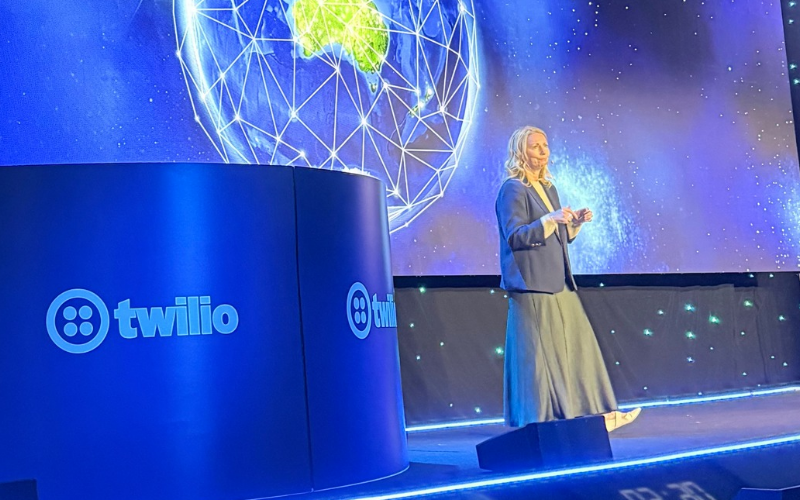
Twilio gathered hundreds of enterprise leaders, software architects, and product developers for the Australian leg of its SIGNAL World Tour 2026. Chris Koehler, Chief Marketing Officer, in the kick-off presentation, described the strategic shift in enterprise technology, arguing that the future of customer experience depends on open, flexible infrastructure rather than proprietary, closed AI systems.

“As AI becomes central to how businesses serve their customers, retaining control matters more than ever. It has to be open. No vendor lock-in, no walled gardens. You should be able to bring your own models, your own data, and your own tech stack, built on neutral infrastructure you can trust at scale.”
“Seventeen years ago, we backed the idea that every developer would need a reliable way to reach people. Today, our bet is that every AI agent will need that exact same foundation. It’s moving us from searching and navigating websites to a world that’s entirely conversational, where things simply get sorted out behind the scenes”, says Koehler.
The day-long summit focused on transitioning enterprise digital customer experience from fragmented messaging channels into a unified orchestration layer purpose-built for the agentic AI era. In her opening keynote session, Kathryn Murphy, SVP Product at Twilio, outlined how the communications platform-as-a-service (CPaaS) model is shifting from discrete messaging and voice APIs toward contextual, cross-channel orchestration.

“If your underlying infrastructure is a bit of a mess, slapping AI on top doesn’t fix anything, you just scale the breakdown. You end up going from one clunky interaction to 500 faster, far more confident broken experiences. The tech got smarter, but the customer experience went backwards. This isn’t an AI failure; it’s an infrastructure problem”, says Murphy.
“Right now, teams spend more time stitching mismatched systems together than they do actually building great experiences for their customers. When someone switches from a chat to a call, the context vanishes and they’re forced to start from scratch. We need to stop stitching and simply start building proper conversations.”
New products announced

The standout product announcement on the day, according to Audrey William, Founder and Principal Analyst at CrayonIQ, was Conversation Memory, “When customers bounce across channels, jump onto voice AI, and then hand over to a human agent, context has to be preserved. If they ring back a month down the track, that thread needs to stay intact. Neither the agent nor the voice AI should have to go digging for background info, and that’s precisely why a capability like Conversation Memory is so critical.”
The other announcements spotlighted during the Sydney event centered on removing the friction of deploying production grade AI agents:
- Twilio Agent Connect (TAC): Headlining the developer track, Twilio showcased Agent Connect, an open-source SDK available in Python and TypeScript. TAC pre-wires Twilio’s core communications infrastructure, including Voice, SMS, WhatsApp, and Web Chat, directly into LLM application frameworks, allowing teams to build autonomous conversational agents without bespoke protocol glue code.
- Conversation orchestrator & conversation memory: TAC works in tandem with Twilio’s Conversation Orchestrator to maintain persistent cross-session and cross-channel context. This native memory retrieval capability enables AI agents to retain customer history whether a user transitions from an automated web chat to an outbound voice call or SMS. Murphy comments, “”The goal here isn’t just stockpiling channels for the sake of it. It’s about giving developers the flexibility to craft the exact journeys their customers genuinely want, whether that kicks off with an RCS message, escalates to real-time voice, or moves straight into Microsoft Teams.”
- Deterministic human handoff: Demonstrations highlighted native failover workflows that allow autonomous AI agents to trigger real-time, context-preserving handoffs to human support agents when sentiment triggers or intent boundaries are reached.
According to William, Twilio’s ‘Super Network’ positions the company as one of the few providers capable of supplying the critical, large-scale infrastructure required for voice AI and autonomous agents. She says, “In the early days, the underlying plumbing was never particularly glamorous, no one really talked about infrastructure. But in this era of voice AI and autonomous agents, robust infrastructure is non-negotiable, and Twilio’s ‘Super Network’ puts them in a very elite group alongside a handful of vendors and the hyperscalers capable of delivering at this scale.”
“To get voice AI right, you need rock-solid infrastructure to cut latency, ensure seamless and compliant AI-to-AI handoffs, guarantee ironclad security when passing over to human agents, and flag fraudulent activity in real time. Without that foundation, enterprises inevitably run into legacy roadblocks and lack the essential guardrails for governance, policy enforcement, and control. Reliable infrastructure has become more critical than ever, and that plays straight to Twilio’s core strengths.”
Locals on stage

The event brought prominent regional industry leaders into the conversation. Vincent Wong, Head of Product at Atlassian, joined Twilio on stage to discuss designing resilient experiences at enterprise scale. “For years, customer support has been written off as a cost centre tucked away in the background. But the reality is, these teams hold massive value for an organisation. They’re on the frontline talking to customers every single day. They have the context, they know where the pain points are, and they understand how the business is actually performing. That frontline insight is pure gold”, says Wong.
He adds, “When AI reliably handles the front-line volume around the clock, it completely changes the dynamic. Support teams stop spending their whole day firefighting. That frees people up to focus on high-impact work, refining workflows, coaching AI agents, and feeding customer insights straight back to R&D so the business can build better products in the first place.”
Dawid Naude, Chief AI Officer at Affinda, delivered an address on practical enterprise automation, demonstrating real-world deployments where AI agents handle complex document-driven workflows and customer triage in real time. Naude stressed that automation in sectors like finance, insurance, and recruitment requires full auditability. Every extracted field must link back to its exact coordinate on the source document, providing a transparent provenance trail that satisfies compliance and regulatory standards.
“This is an area where Twilio can truly showcase the strength of its Super Network”, advises William. “Imagine sending a personal AI agent to check your bank balance, execute a funds transfer, and then follow up a week later on an issue, you’re delegating highly sensitive, confidential tasks to autonomous software. In that world, identity verification is non-negotiable; organisations must be certain these AI agents are legitimate, not scammers or fraudulent actors. Having an underlying network that can verify agents and detect malicious activity delivers the crucial layer of governance and security enterprises need for high-stakes transactions.”
Attendees spent the afternoon across technical breakout sessions and “The Builder Hub,” testing live builds of Agent Connect and examining architectures built on Twilio’s carrier-level compliance and fraud-prevention layer.
