

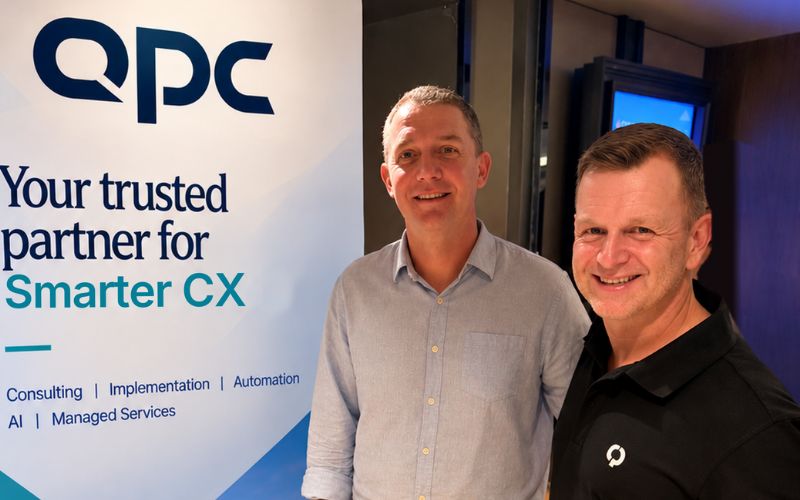
QPC Australia has significantly expanded its executive leadership team, adding two prominent industry figures to help Australian contact centres and customer experience (CX) teams navigate an increasingly AI-driven market.
The specialist contact centre, CX and AI partner has appointed Dave Flanagan as Strategy and Partnerships Director and has welcomed back Paul Jones as Strategic Customer Director. The pair join QPC’s executive leadership team to strengthen QPC’s advisory capabilities and support organisations making key technology investments.
“We’ve always led with business context, but this expansion gives us the bandwidth to support growing client demand,” said Scott Chambers, Managing Director of QPC Australia. “It’s part of our biggest investment in a decade, ensuring we stay ahead of rapid market changes so we can proactively guide our clients when they’re ready to take the next step.”

Dave Flanagan brings more than 18 years’ experience leading customer experience, digital innovation and AI initiatives in Australia and internationally. As Strategy and Partnerships Director at QPC Australia, he will help shape the company’s growth and guide organisations through AI and customer experience transformation. He commented, “Go live is no longer the finish line; it’s the start line. Most contact centres have made the shift to the cloud, and the real challenge now is figuring out how and where to leverage AI to extract actual value”.
“More than half of QPC’s customers have moved AI beyond the pilot and into everyday operations. One member-owned bank took AI from a small pilot to its entire frontline team in 6 weeks, and a large national consumer brand modernised their voice, digital and frontline service with AI in a single 12-month program”.
“While budgets are becoming available, appetite varies widely. Some view AI as a high-risk gamble, while others have open mandates to fund it,” said Flanagan. “Our role is to narrow that gap. That requires a completely different type of partner than the market needed a few years ago: one who can help clients determine how, where and when to embed AI across customer and employee journeys and, as agentic AI starts to take actions, how much autonomy to give it.”

Paul Jones is returning to strengthen the company’s enterprise advisory capabilities and ensure clients get real business value out of their CX, AI, and contact centre investments. His return is driven by a combination of strategic alignment, deep operational experience, and established industry relationships. “”It really comes down to value: value in the platform and value in our partnership. Platform capabilities are advancing so rapidly that existing roadmaps can quickly become obsolete, and clients need guidance to navigate that shift”, said Jones.
“Contact centre AI is now an executive level conversation. If you present a sound business case, funding is there, but the risks of choosing the wrong approach are high. The real test isn’t running a pilot to show action, but scaling the technology to deliver measurable value.”
“For regulated industries, the bar is higher. In government, financial services and health, the question isn’t whether to use AI. It’s how to use it safely and prove it. If you can’t show how the AI reaches its decisions and who owns them, the project won’t scale”, said Jones.
Governance hasn’t kept pace with rollout: 83% of Australian organisations are using AI in some part of the business, but only 21% have a formal AI governance or policy framework (Konica Minolta and Omdia, 2026).
Closing that gap is where Chambers sees QPC’s role, “As contact centres move past simple cloud adoption to face the complexities of scaling AI, our goal is to help them navigate the risks, refine their roadmaps, and extract genuine business value from their investments. This expansion ensures we have the deep strategic expertise and bandwidth to guide Australian organisations into their next phase of growth.”
What’s next?
The economics: The shift toward generative and conversational AI is fundamentally altering how contact centres budget for technology. “Unlike seats, where there was a fixed price per agent per month and you could easily map it out, this fluctuation in AI tokens is something that needs constant supervision and management,” said Flanagan. “As you enable different features, the spend on AI fluctuates, requiring continuous optimisation to manage potential costs and benefits”.
“Someone needs to sit on the customer’s side of that meter,” said Chambers. “That’s what our managed service is built for.”
The priorities: “For the next 12 to 24 months, CX leaders need to focus on three critical priorities: understanding their platform ecosystem, establishing a strong knowledge framework, and building a data framework that validates where value is actually being achieved”, advises Jones.
Do something: “When looking at a rapidly evolving market, the challenge for customers is seeing two extremes: do nothing and wait, or do everything. Neither is the right answer. The right answer is to do something, establish a roadmap, deploy the technology, measure it, learn from it, and keep moving forward”, concludes Chambers.
Since 1989, QPC Australia has positioned itself as a primary architect of customer and employee experience across the region. Anchored by a 25-year partnership with Genesys and a network of over 50 certified specialists across five national offices, the company manages integrations uniting contact centre, CRM, and AI technologies for more than 100 enterprise clients in Australia.
