

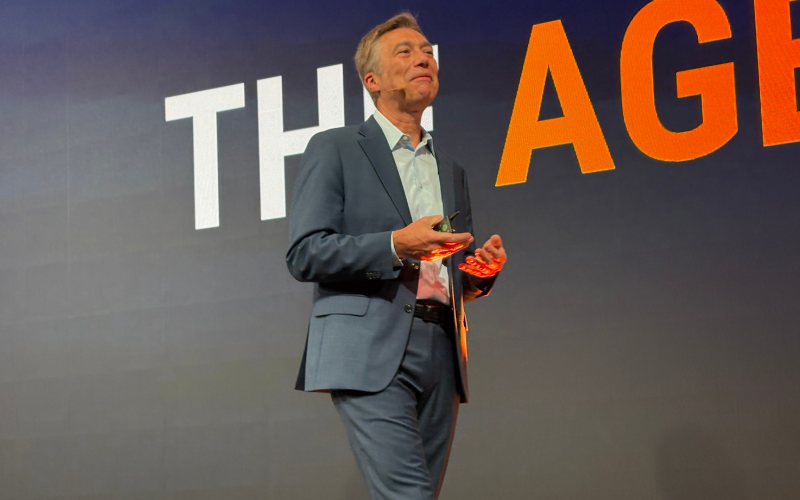
The main theme of Genesys Xperience APAC 2026 in Sydney on November 11–12, was ‘Mastering Universal Experience Orchestration’, showcasing how Genesys is re-architecting Genesys Cloud to coordinate human employees, autonomous AI agents, and incoming consumer bots across a complex Asia-Pacific CXl and contact centre landscape.
Genesys’s evolution reflects the broader transformation of the customer experience and contact centre space, moving from rigid, hardware heavy call centres to agile cloud platforms handling multiple digital and voice channels, and now toward autonomous, AI-driven experience orchestration.

In his keynote presentation, Senior Vice President Peter Graf outlined Genesys’s strategic pivot from a traditional Contact Center as a Service (CCaaS) provider into an agentic orchestration platform and context machine. “In order to do AI right, Genesys is turning into a context machine on an AI platform, activating context across the enterprise to orchestrate towards the desired outcome of the customer. It’s that context driving orchestration across a hybrid workforce of human and AI agents that delivers world-class experiences, and that goes far beyond simple automation or copilots.”
Graf emphasised that succeeding in the agentic era requires shifting simultaneously across five areas, moving from one-off interactions to connected, multimodal memory (including AI-to-AI interactions); managing a unified hybrid workforce; optimising for business outcomes rather than deterministic workflows; building governed autonomy (access, observability, and regional regulatory compliance) directly into the architecture, and treating AI adoption as an ongoing operational transformation.
Building an agentic foundation
Genesys is betting that by building on its traditional strengths in voice and routing with AI orchestration, it can transition itself from a specialised contact centre or CCaaS vendor into a broader enterprise player in agentic AI. To this end Genesys highlighted the agentic orchestration architecture that’s been built inside Genesys Cloud:
- AI control & Contextual Intelligence: Acting as the governance backbone, this layer enforces compliance guardrails while maintaining real-time customer journey memory across voice and digital channels. “Governance is not an add-on to agentic AI. Governance is the prerequisite of agentic AI. It has to be built into the architecture”, says Graf
- Genesys Cloud Navigator & Orchestrator: Functioning as an intelligent routing layer, Navigator and Orchestrator dynamically coordinate resolution paths across autonomous AI agents, human specialists, and third-party backend systems.
- Agentic Virtual Agent (AVA) Upgrades: Moving beyond static conversational trees, Genesys’s upgraded virtual agents leverage Large Action Models (LAMs) via Scaled Cognition to execute multi-step tasks. Voice interactions also received notable latency and realism upgrades through End-of-Turn Detection, Contextual Tuning, and native integrations with ElevenLabs and Deepgram. Meanwhile, Genesys’s acquisition of Pinkfish brings more than 500 out-of-the-box Model Context Protocol (MCP) integrations into enterprise platforms like ServiceNow, SAP, and Salesforce.
Anticipating a surge in consumer-owned AI assistants contacting businesses on behalf of users, Genesys highlighted its work alongside Meta and Sierra to establish a verification standard for personal agents. To support this cross company ecosystem, the vendor is leaning heavily on its acquisition of Pinkfish, which provides immediate access to 500 Model Context Protocol (MCP) connectors across major enterprise systems.

“Through our acquisition of Pinkfish, we gained out-of-the-box access to 500 different MCP connectors into major enterprise systems,” said Albert Nel, Senior Vice President and Regional Sales Leader Asia Pacific & Japan speaking on the sidelines of the event. “Previously, when backend systems updated their APIs, you had to manually reconfigure integrations. With Pinkfish, those connectors are self-healing, they automatically refresh to maintain consistency. That is going to be critical as we move into a world where AI agents aren’t just talking internally, but across different companies and partner organisations.”
Preparing an ‘AI front door’ for consumer bots and AI assistants
A recurring strategic theme in Sydney was how enterprises will defend their contact centres and frontline teams against an impending wave of consumer-side personal agent, and how APAC’s uneven cloud maturity shapes readiness. While Australia and New Zealand operate almost entirely in the cloud, high-growth markets like India, Thailand, and the Philippines are accelerating their cloud migrations specifically to unlock agentic capabilities.
“With the introduction of consumer personal agents, the way consumers behave is going to change considerably,” Nel noted. “Instead of personally going onto a chatbot or calling a contact centre, it will be very easy to schedule a personal agent to engage with a brand on your behalf. That is probably the biggest challenge for organisations, because suddenly the volume hitting your contact centre is going to explode.”
Without verification standards, consumer bots using a customer’s credentials can slip through interactive voice response (IVR) systems undetected. Nel explained that the new protocol developed with Meta, Sierra and others introduces a digital certificate to authorise who an incoming agent represents, allowing enterprises to enforce rate limits and liability guardrails through an ‘AI front door like Genesys Cloud Navigator.
Governance, sovereignty, and human empathy
Because APAC spans diverse regulatory regimes, from Australia’s IRAP framework to Japan’s ISMAP standards, data sovereignty and trust dominated leadership panels. Genesys emphasised that regional infrastructure expansions across Sydney, Mumbai, and Singapore are designed to keep heavily regulated financial and government workloads compliant while rolling out top-tier security controls globally.
Crucially, speakers stressed that automation must elevate rather than replace human empathy. Sessions featuring Australian crisis support service Lifeline underscored the necessity of knowing precisely when technology must step back for human intervention.
“When less critical, volume-based work is offloaded to AI agents, your human agents are left handling only the most complex situations that require genuine empathy,” Nel said. “That introduces the risk of cognitive overload. Traditional contact centre metrics like average handle time and containment will have to change, because in this new operating model, you have to put human agent wellbeing at the heart of how you schedule breaks and manage workloads.”
From prototype to production on the show floor
In the Orchestrators Hall, technical teams demonstrated how enterprises can move faster without sacrificing control, showcasing spec driven development for AI agents alongside Genesys’s newly launched Forward-Deployed Engineers (FDEs) to accelerate production rollouts.
Real-world momentum was further anchored by the 2026 Genesys Orchestrators Innovation Award finalists and regional healthcare leaders, who demonstrated how real-time speech-to-text and automated knowledge surfacing are stripping away administrative friction. By unifying human and virtual workforce management under a single governed platform, Genesys is betting that the next era of APAC customer experience will be defined not by how much organisations automate, but by how safely and empathetically they orchestrate it.
