
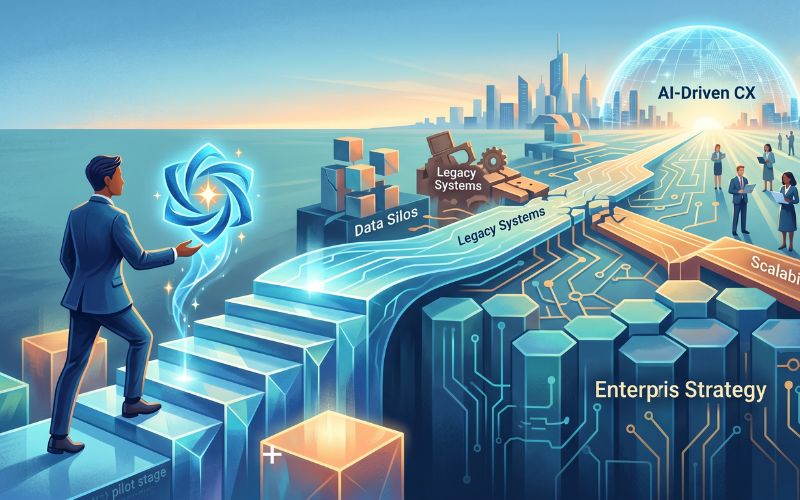
The Australian customer experience (CX) landscape has reached a critical inflection point. The era of speculative AI experimentation is drawing to a close, replaced by an urgent mandate for enterprise-wide integration. While the first half of 2025 saw a staggering 119% surge in AI agent adoption across the country, moving these initiatives out of the incubation lab and into sustainable production remains a critical challenge for CX /IT leadership.
CXFocus’s recently published industry report From AI Pilot to Enterprise Strategy: Addressing the Realities of AI-Driven CX, identifies the challenges that organisations must systematically address to transition from disjointed tools into an enterprise strategy.
The 2025–2026 Australian AI CX landscape by the numbers
To appreciate the scale of the structural shift taking place, enterprises must confront a stark reality: while ambition is exceptionally high, execution remains unevenly distributed. The data indicates a significant gap between initial investment and realised value.
| Category | Key Metric & Source | Operational Implication |
| Strategy & Ambition | 78% of Australian boards consider AI a core strategic pillar (Adobe Australia). | Ambition is clear at the executive level, yet only 10% of businesses are investing in a truly holistic, enterprise-wide manner. |
| The Pilot Trap | Only 25% of Australian organizations have scaled at least 40% of their AI pilots into production (Deloitte). | The majority of enterprises remain stuck in isolated, localized trial environments. |
| The Value Gap | 72% of CX and IT leaders report a failure to achieve measurable ROI from initial investments (Adapt Research). | Fragmented, siloed applications fail to deliver systemic operational dividends. |
| Consumer Skepticism | 90% of consumers will actively share negative experiences if an enterprise AI is inaccurate (Adobe Trust Report). | Public tolerance for malfunctioning, ungrounded conversational bots is virtually zero. |
Despite these challenges, mature adopters are realising substantial performance dividends. Successful implementations have yielded a 38% reduction in average call handling times in financial contact centers, while macroeconomic forecasts from Gartner project enterprise AI ROI to scale from a current median of 10% up to 29% by 2028 as systems migrate toward fully autonomous agentic models.
Deconstructing the realities of the AI Frontier
The report identifies four foundational challenges that organisations must systematically address to transition from disjointed tools to integrated engines of innovation.
1. The data paradox – moving from data-rich to insight-ready
Most Australian organisations suffer from being “data rich but insight poor.” Despite heavy financial capital deployed into data storage, only 24% of enterprises possess an AI-ready data architecture. Without a modernised foundation, advanced implementations suffer from severe data latency and fragmentation.
The technical requirement to resolve this in 2026 is the adoption of Zero Copy Architecture paired with Unified Data Streams. Traditional data management relies on copying and moving heavy datasets across environments, introducing interface overhead, latency, and security liabilities.
“The era of ‘move and wait’ is over,” notes Anthony Gebbie, General Manager, Enterprise Digital Services (Public Sector) at Nexon Asia Pacific. “By implementing a Zero Copy Architecture, you eliminate traditional friction between the OS kernel and userspace, ensuring data remains in its original, secure location. We are effectively shrinking the attack surface while accelerating application performance.”
Unified Data Streams act as a continuous living nervous system, allowing Agentic AI models to process real-time events alongside historical archives, turning data into predictive intelligence rather than static snapshots.
2. Eliminating vendor noise with plug-and-play architecture
The current technology market is saturated with siloed tools. To build a resilient ecosystem, leading enterprises are maximising their existing core stacks—such as Microsoft, AWS, Google, Genesys, or ServiceNow—and linking them via a robust API layer.
NAB exemplifies this structured approach. The institution scales its artificial intelligence initiatives by enforcing a centralised AI Platform that dictates strict enterprise-wide guardrails for risk, security, and governance. Within those secure boundaries, individual business units utilise a federated approach to configure custom solutions.
Similarly, Uniting launched its AI agent, Buddy, moving it from an incubation lab to a production-level tool utilised by thousands of frontline aged care workers. Through voice-to-text integration, workers dictate progress notes directly into their devices post-visit. Buddy automatically translates the audio from over 50 languages into English, standardises the metrics, and updates clinical systems directly, creating a single “front door” for employee documentation.
3. The shift to digital labour
As AI agents take on advanced, customer-facing roles, organisations are transitioning to a human resource management framework for AI agents. AI performance can no longer be judged strictly on system uptime, it must be audited against behavioural frameworks and brand alignment.
At Charles Sturt University, an agentic AI named Charlie provides 24/7 empathetic support to students. Rather than operating as an unmonitored black box, Charlie is subjected to the exact same Quality Assurance (QA) scorecards as human operators.
Managers utilise automated QA auditing tools to review conversation transcripts, actively monitoring for behavioral drift or technical hallucinations. This structural oversight is giving rise to critical new professional roles, specifically AI Orchestrators and Algorithmic Auditors, who manage the delicate intersection of code, corporate culture, and compliance.
4. Mitigating risk and redefining the status quo
The risk of Large Language Model (LLM) hallucinations remains a primary hurdle to adoption. When restaurant chain El Jannah launched its AI pilot to automate customer interactions via WhatsApp, it countered this vulnerability by front-loading the system with structured knowledge articles and an extensive directory of pre-approved FAQs.
However, market leaders are also redefining how risk is quantified. As David Russell, General Manager of IT Services at Nexon Asia Pacific, notes:
“While fear of AI hallucinations is high, market leaders are increasingly acknowledging the risks of the status quo—where human agents rely on outdated PDFs or siloed notes.”
The empathy dividend – A new ROI framework
Historically, technological ROI was calculated through a defensive framework: cost reduction, headcount containment, and hours saved. Forward-thinking Australian enterprises have turned this metric on its head, shifting to an offensive metric: value reinvested.
When systems like CSU’s Charlie or Uniting’s Buddy absorb thousands of hours of high-volume, mundane administrative tasks, the true commercial value lies in how organisations redeploy that reclaimed human capacity. This is known as the ‘empathy dividend’.
By allowing automation to execute the baseline 80% of routine queries, human operators are liberated to dedicate undivided emotional intelligence to the remaining 20% of high-stakes, nuanced customer interactions—such as complex financial disputes, aged care compliance, or insurance claims. In this updated paradigm, Net Promoter Score (NPS) measured during high-stakes interactions serves as a direct lead indicator for long-term customer Lifetime Value (LTV) and brand retention.
Orchestrating the new era of intelligence
The window for strategic hesitation is rapidly closing. Transitioning from isolated, localized experiments to a unified, enterprise-wide ecosystem is no longer an optional competitive advantage; it is a baseline requirement for operational survival.
To successfully navigate this landscape, executive leadership must orient their strategic roadmap around three core pillars:
- Infrastructure: Transitioning away from fragmented, disparate vendor tools and modernising legacy stacks through Zero Copy Architecture and unified data streams.
- Governance: Moving away from the “black box” model by subjecting digital labour to the same rigorous QA scorecards, ethical boundaries, and human-in-the-loop oversight applied to human staff.
- Vision: Integrating customer and employee journeys into a singular, fluid framework that leverages automation to erase administrative friction.
The organisations that will dominate the coming decade are those that stop viewing AI as a series of isolated IT projects, and instead begin architecting a highly integrated, AI-augmented enterprise.