
Customer expectations are evolving rapidly in today’s digital-first economy. Businesses are under constant pressure to deliver faster responses, personalised experiences, and 24/7 support across multiple communication channels. This growing demand has accelerated the adoption of artificial intelligence (AI) in customer service, enabling organisations to streamline operations while improving customer satisfaction.
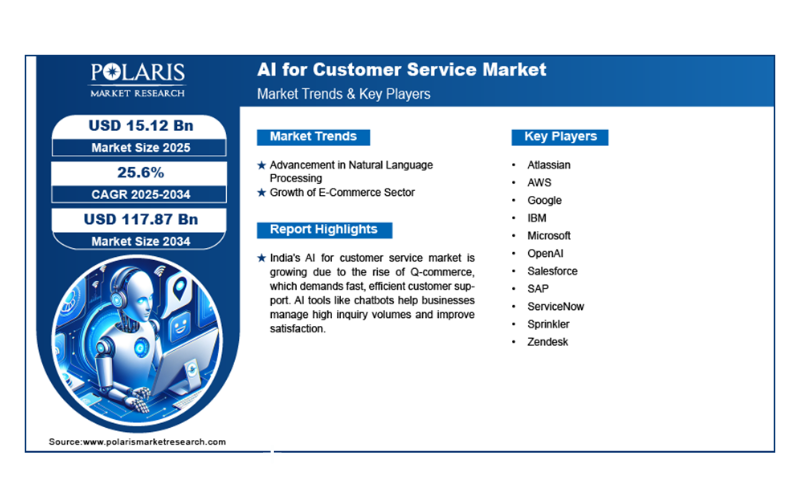
The global AI for customer service market was valued at USD 12.10 billion in 2024 and is projected to reach USD 117.87 billion by 2034, growing at a strong CAGR of 25.6% from 2025 to 2034.
The global AI for customer service market is witnessing remarkable growth as companies across industries increasingly integrate AI-powered technologies such as chatbots, virtual assistants, sentiment analysis tools, and automated ticketing systems into their support operations. According to Polaris Market Research, the market is projected to grow significantly over the next decade due to advancements in natural language processing (NLP), machine learning, and generative AI technologies.
The rising demand for AI in customer service
Modern consumers expect businesses to respond instantly to their concerns, regardless of time zones or business hours. Traditional customer support models often struggle to handle high volumes of inquiries efficiently, especially during peak demand periods. AI-powered customer service solutions help organisations overcome these challenges by automating repetitive tasks and improving response efficiency.
AI tools can analyse customer queries, understand intent, and provide accurate responses within seconds. This not only reduces wait times but also allows human agents to focus on more complex issues that require empathy and critical thinking. Industries such as retail, banking, healthcare, telecommunications, and e-commerce are increasingly leveraging AI-driven support systems to enhance customer engagement and reduce operational costs.
Chatbots and virtual assistants lading the transformation
One of the most widely adopted AI technologies in customer service is the chatbot. AI-powered chatbots and virtual assistants can handle thousands of customer interactions simultaneously while maintaining consistent service quality. These tools assist customers with order tracking, appointment scheduling, billing inquiries, troubleshooting, and product recommendations.
Unlike traditional rule-based systems, modern AI chatbots utilise NLP and machine learning to deliver human-like interactions. They continuously learn from previous conversations and improve their accuracy over time. Businesses benefit from enhanced productivity, while customers enjoy seamless and convenient support experiences.
The growing adoption of chatbots is especially evident in the e-commerce industry, where companies face increasing volumes of customer requests daily. AI-driven automation helps businesses maintain customer satisfaction while managing large-scale operations efficiently.
The role of generative AI in customer experience
Generative AI is emerging as a game-changing technology in the customer service landscape. Unlike conventional AI systems, generative AI can create context-aware and personalised responses based on customer behaviour, preferences, and historical interactions.
This technology enables businesses to provide more meaningful and engaging conversations with customers. AI systems powered by generative models can draft emails, summarise support tickets, generate tailored recommendations, and even assist human agents with real-time suggestions during live interactions.
The increasing use of generative AI is helping organisations improve customer loyalty and brand perception by delivering faster and more personalised experiences. As companies continue investing in advanced AI capabilities, generative AI is expected to play a central role in shaping the future of customer support.
Advancements in natural language processing
Natural language processing has become one of the key drivers of growth in the AI for customer service market. NLP enables AI systems to understand human language, including tone, intent, context, and sentiment. This allows AI-powered platforms to interact with customers more naturally and effectively.
Modern NLP technologies can identify customer emotions, detect frustration, and escalate complex issues to human representatives when necessary. This combination of automation and human intervention improves overall customer satisfaction while maintaining operational efficiency.
Additionally, multilingual NLP capabilities are enabling businesses to support global customer bases without requiring extensive multilingual support teams. As NLP technology continues to advance, customer interactions are expected to become even more intuitive and personalised.
AI Adoption Across Industries Organisations across multiple sectors are increasingly integrating AI into their customer service strategies. In the banking and financial services industry, AI-powered assistants help customers with account inquiries, fraud detection, and transaction support. Healthcare providers use AI chatbots for appointment scheduling, patient engagement, and medical information support.
Retail and e-commerce companies are among the largest adopters of AI customer service technologies due to the need for continuous customer engagement and rapid query resolution. Telecommunications companies are also implementing AI solutions to manage technical support and billing inquiries efficiently.
North America currently leads the global AI for customer service market due to strong technological infrastructure and widespread adoption of digital solutions. However, the Asia Pacific region is expected to witness rapid growth as countries such as India, China, and Japan continue expanding their digital economies and investing in AI technologies.
Challenges and future outlook
Despite its advantages, implementing AI in customer service comes with certain challenges. High initial investment costs, data privacy concerns, and integration complexities remain significant barriers for some organisations. Businesses must also ensure that AI systems maintain transparency, fairness, and security when handling sensitive customer information.
However, continuous advancements in AI technologies and increasing cloud adoption are expected to make AI-powered customer service solutions more accessible and scalable in the coming years. Companies that successfully integrate AI into their support operations are likely to gain a competitive advantage by delivering faster, smarter, and more personalised customer experiences.
As digital transformation continues to reshape global industries, AI is poised to become an essential component of modern customer service strategies. Businesses that embrace intelligent automation today will be better positioned to meet evolving consumer expectations and drive long-term growth in the future.