

We all know AI is helping businesses get more done, faster.
It can help summarise the customer call, draft the follow-up, pull together the research, analyse the data, find an answer and turn a task that used to take an afternoon into something much, much quicker.
Which all sounds great on paper.
Except the work doesn’t necessarily feel easier.
Recent research corroborates that Australian businesses are adopting AI at pace. ABS data shows 12% of businesses used AI in 2024–25, up from just 1% two years earlier, with usage among large businesses reaching 35%. Microsoft’s 2026 Australian Work Trend Index also found 63% of Australian AI users said they were producing work they couldn’t have produced a year earlier.
So yes, AI is certainly making us faster.
But there’s another side of that equation that matters enormously for customer experience: what is happening to the work behind the experience?
Because Australian HR Institute research found 60% of organisations surveyed said workloads were increasing, with three in five respondents also agreeing AI was increasing work intensity.
That feels like the real tension.
We’re very focused on what AI can save. Maybe we should spend a bit more time asking what happens after the saving is made.
The customer sees the experience. The employee sees everything behind it
Think about a relatively simple customer interaction.
From the customer’s perspective, it might take five minutes. They ask a question, someone finds the answer and the issue gets sorted.
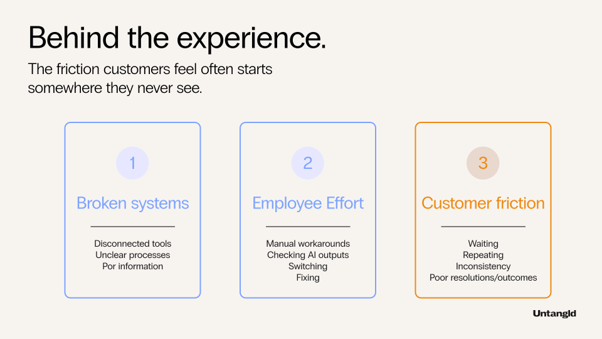
Behind those five minutes, the employee might be jumping between multiple systems, searching through an old knowledge base, waiting for an approval, copying information from one place to another, checking an AI-generated response, or fixing something manually before the customer ever notices there was a problem.
The customer sees five minutes.
The employee sees the machinery behind the five minutes. That distinction matters because customer experience and employee experience are closely connected. Sometimes a smooth customer experience is only smooth because someone internally is doing a lot of (over)compensating.
Good employees are incredibly good at this. They learn the workarounds. They know which systems not to trust, who to call and how to patch a gap before it reaches the customer.
The problem is that those workarounds can make a broken system look like it’s working normally. Then AI gets layered on top. The front end becomes faster, while much of the underlying complexity stays exactly where it was.
In some cases, we’re not even removing friction at all. We’re just moving it somewhere the customer can’t see.
If AI saves time, where does the time actually go?
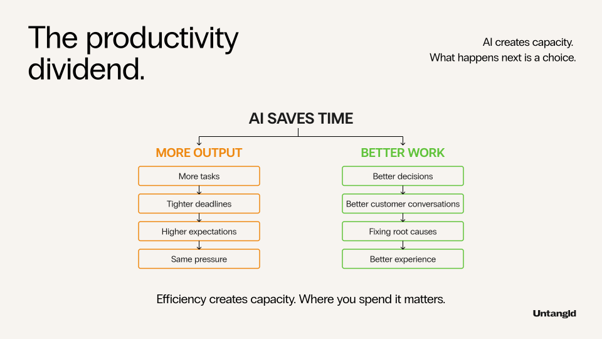
Say a task used to take four hours and now takes two. In a standard business case, that’s easy: you’ve saved two hours. In real life though, those two hours rarely sit there untouched.
Another task lands, the deadline gets shorter, the team takes on more and the expected output quietly shifts.
And before long, what used to feel fast starts to balance out as normal. That’s not necessarily bad management. It’s just how organisations tend to work. Once something becomes easier, we usually ask for more of it.
Which is why I’m not sold that “time saved” is the most useful measure of AI success on its own.
Microsoft’s 2025 Australian Work Trend Index found that 47% of leaders believed productivity needed to increase, while 79% of employees and leaders said they lacked enough time or energy to actually do their work.
A business can be getting more productive while the people inside it still feel completely maxed out.
And from a CX perspective, that should really really matter.
Because if the people delivering the experience are dealing with greater workload, more complexity and/or constant workarounds behind the scenes, eventually some of that friction is going make its way through to the customer.
AI doesn’t always remove the work. It changes it.
AI can absolutely get rid of some of the boring stuff: transcribing, drafting, sharing, summarising, formatting, searching for information and processing routine enquiries.
That’s pretty useful support. But work doesn’t always disappear because a tool has made one part of it faster.
Someone still needs to check the answer, spot when something is wrong, decide when AI should be used and when it shouldn’t. Someone still has to learn the new tool, handle the exception and pick up the nuanced customer issue when the automated flow reaches something it wasn’t designed for.
Jobs and Skills Australia’s Generative AI Capacity Study has concluded that AI is more likely to augment jobs and change how work is done rather than simply remove work altogether.
That’s a much more useful lens – especially in customer-facing work.
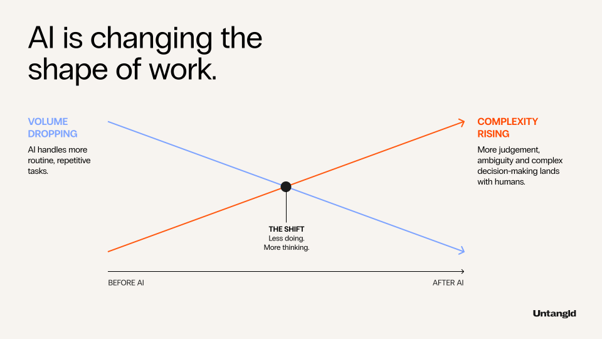
As AI handles more of the simple, repeatable interactions, the unusual and messy ones are increasingly the ones left for real people to handle.
The straightforward customer enquiry gets automated. The emotionally charged one still needs a human.
Basic analysis can be generated instantly. The harder call about what it actually means still requires human judgement.
A first draft is easy. Knowing whether it’s actually any good is much harder to decipher.
Microsoft’s latest 2026 Australian research reflects this shift, with workers increasingly ranking ‘critical thinking’ and ‘quality control’ among the most important human skills in an AI-enabled workplace.
So a role can contain fewer repetitive tasks while becoming more cognitively demanding overall.
Less admin, perhaps. But more judgement, ambiguity, exceptions and pressure to get the important bits right.
If all we measure is hours saved, we can miss that change completely.
The productivity dividend is a choice
This isn’t an argument against optimisation. Quite the opposite actually. If AI is genuinely giving us back time, businesses have an opportunity to be much more deliberate about how they spend it.
Does that extra capacity go into more customer conversations? Better decisions? Fixing the process that keeps causing the same problem? Learning? Coaching? Resolving an issue properly the first time?
Or does it simply just become more output?
Safe Work Australia already recognises unreasonable time pressure, role overload and sustained mental or emotional effort as risks that can arise from how work is designed and managed. AI doesn’t make those questions disappear. If anything, it makes them more important. Because if a two-hour task suddenly takes 30 minutes, “great, now do four of them” is only one possible (lazy) answer. There are other options!
CX leaders need to look behind the journey
For years, customer experience teams have been trained to look for friction.
Why did the customer drop out? Why did they have to repeat themselves? Why was this process confusing? Why did something take five steps when it could take two?
All good questions, but we also need to apply the same level of curiosity to the work employees are doing behind those interactions.
- Where are they constantly fixing, checking and working around things?
- Which systems or processes create unnecessary effort?
- Which parts of the job genuinely add no value?
- Which parts only look inefficient because they require nuanced judgement or care?
- And when AI creates capacity, where does that capacity go?
Looking at customer and employee experiences side by side can unveil where the friction actually lives, rather than simply where it happens to show up.
AI can absolutely help, but “faster” is a pretty low bar on its own.
The more useful measure of the productivity dividend is whether the work has become easier to navigate, easier to do well and, ultimately, better for the customer at the other end.
Businesses are going to get faster – that part seems pretty certain already.
It’s whether work actually gets better that’s still up to us.
Sources
- Australian Bureau of Statistics, Business adoption of Artificial Intelligence accelerates in 2024–25
- Australian HR Institute, research on AI, workload and work intensity
- Jobs and Skills Australia, Australia’s AI Transition: Jobs, Skills and the Future of Work
- Microsoft, 2025 Australian Work Trend Index
- Microsoft, 2026 Australian Work Trend Index
- Safe Work Australia, Managing psychosocial hazards at work: Code of Practice